What the mountains never told… Asha did
Behind the peace visible in the mountains of Uttarakhand, lies a hidden story…. of Asha. A smiling woman, whose life’s threads slowly unravel, bringing to the surface dreams, responsibilities, and paths that were left incomplete. From the games of childhood to studying in secret, and then the search to rediscover oneself in a new way, this is not just the story of one life. It is a glimpse into those unspoken lives that are lived every day, without ever being heard. Asha’s story will not merely tell you something, it will force you to think, what is it that hides behind strength?

Storyteller- Sangeeta Dev
Himal Prakriti Storyteller
Champawat, Uttarakhand
Read this story in Hindi
I knew her only as the person she always appeared to be. Dedicated, patient, and someone who could make you laugh. But her real story, the story of her life, we never knew. Then one day, sitting together as we often did, a small thread of conversation came loose… and we were left stunned by how deep a story lay behind that thread.
Khetikhan and Champawat are two different places nestled among the hills of Uttarakhand, both situated in Champawat district, where mornings arrive with the sound of birds and evenings dissolve into the sun sinking behind the mountains. From the outside, these hill regions always appear so calm with tall deodar trees, the green of open fields, and the scent of mountain earth carried in the wind. Everything is so beautiful that you’d think life here must be easy for everyone. But hearing her story, it struck me for the first time that the most beautiful places can hold the deepest silences and it is often the women of these places who carry those silences the most.

Asha was one of those women. We had always seen her smiling, but we never knew how many years of struggle, how many responsibilities, and how many buried dreams lay behind that smile. From that day on, her story was no longer just a story, it became a journey that needed to be understood.
She sat before me in her courtyard, settled in the afternoon sun, legs stretched out without a care, wearing a deep green salwar, her warm slippers set to the side, and a dupatta that always seemed to make her feel at ease. As she spoke, she would sometimes gesture with her hands, and sometimes pull me into her imagination, as though she were living those moments all over again.
The expressions on her face kept shifting, just like her story, her laughter, her silences, her regret, her anger.
There was a soft smile and a quiet glow on Asha’s face as she spoke about those precious moments spent with her friends. It was a time when children would look at the things around them and invent their own games, entirely from imagination, and play them with their whole hearts.
Asha and her friends did the same. They created a game of their own and named it “Dhun–Dhun.” In this game, they would fill a sack with dry pine needles, carry it all the way up to the top of the hill, and then send it rolling down. Whoever’s sack reached the bottom first, won. And they would play it again and again, filling the sack each time, laughing and chatting, climbing back up the hill, ready to go once more.
As I listened to Asha’s story, I found myself quietly comparing my generation to hers. In their time, children made games out of whatever was around them. In ours, games have mostly shrunk down to a screen.
Games back then were not just about winning, they were about being together. And suddenly, a question lingered in my mind: do we even feel that kind of connection today?
With that thought sitting with me, I couldn’t bring myself to ask Asha anything. Perhaps the difference is not in the games themselves, but in the way we play them.

The Age of Dreams, and the Beginning of Choices
Asha now turned the conversation in a new direction. She told us that her family was deeply calm, simple in their ways, and rooted in devotion. Her father was a teacher, her mother a homemaker, and the house was home to nearly twelve people, including her uncle’s children. Yet within this large family, there was a beautiful rhythm. Every evening they would gather together for aarti, her father would sing the bhajans he himself had written, instruments would be played, and only after all of this would the children sit down to study. In such an atmosphere, Asha’s desire to learn only grew stronger. She was a curious girl, eager to know everything, to learn every skill. But many of the girls around her had dropped out of school after the eighth grade. Asha did not. Because her father would always tell her, “If you study today, you will not have to depend on anyone tomorrow.”
Alongside this, he would encourage her to spend her free time doing embroidery and knitting, so that she could find her way into other skills as well.

But there was another truth in that house, her mother’s fear. It was common in those times for a girl to be expected to manage an entire household after marriage, and so her mother wanted Asha to learn the ways of the home alongside her studies. She would tell her that both things were necessary, because no one knew what kind of household she would be married into. And Asha, who wanted to learn everything, would quietly learn household work behind her father’s back, with the same dedication she brought to her studies.
Society keeps reminding the families of girls of the responsibilities they carry. Girls are often seen as another form of responsibility themselves. And those whose daughters get married off are often told, “you have bathed in the Ganga.”
In the same way, people began saying things to Asha’s family, that they still had four responsibilities left. And it was under the weight of this that Asha said yes to her marriage. She was married into a village in Khetikhan, where the women spent their days occupied entirely with the work of the home and the fields.
And now, a new chapter of this story begins…
The Hunger to Learn, and the Roads That Slowed
Society often says that passion has no age. But for Asha, such things never really mattered.
Just as women of that time carried the entire weight of the home on their shoulders, Asha too had to do it all after marriage. In the early days, some of the work was genuinely hard for her. She told us how, one day while cutting grass, she accidentally cut her fingers, both her hands and her feet. The girls of the village would help her when certain tasks felt beyond her. In the mountains, it was common for all the women and girls to go to the forest together, moving in groups.
Slowly, by going along with them, Asha learned everything she had never known before, how to climb trees, how to cut their leaves, and more. In Uttarakhand, forest work is managed through Van Panchayats, so women often go only into the forests that fall under their own Van Panchayat. And now, Asha’s day, from morning to evening, was spent entirely in this work.
Gradually, her studies and her passions quietly disappeared, at least for a while. And yet, even through all of this, she learned another kind of education, the education of her village. Farming, rituals, the Pahari Jhoda songs, she absorbed all of it from the people living around her, and in doing so, built herself stronger within it.
Before her marriage, Asha had taken admission in a Bachelor of Arts course at college. She had a deep interest in Hindi literature and civics. But after marriage, her in-laws refused to let her continue her studies. Yet she did not give up. After a full day of exhaustion from the work of the home and the fields, she would go to her room, close every gap in the doors and windows, light a lamp, and quietly read, losing herself in learning, in silence and in secret.

Because Asha had kept the book with her for so long, a notice arrived one day at her parents’ home from the college, asking for it to be returned as soon as possible. Her brother came to her house to collect it. And in that moment, the family found out that Asha had been studying in secret all along.
Even then, she did not give up. She looked for every possible way to continue her education. She tried to convince her family to let her pursue an opportunity to become an Anganwadi teacher, but they would not agree. Their answer was, “If you go to work, who will look after our cows.”

The moment she said those words, Asha added, “If I were the Asha I am today, I would never have accepted any of this.” And she held her hands in a tight fist for a long time.
The government has made many policies to reduce the gap between boys and girls, but some of these policies are either weak in their design, or fail to reach the ground the way they should. And even now, in some homes, girls are still told they are “paraaya dhan,” a wealth that belongs elsewhere. Financial support from the government does exist, but why does changing the way people think remain so difficult, even today?
A few years later, Asha moved to an urban area of Champawat so that her children could grow up with better opportunities. Those were not easy years. All three of her children were young. Taking them to school and bringing them back, managing the home, and fetching firewood from the nearby village forest for the winters, all of this was part of her daily life. Through it all, she focused on her children’s education and taught them herself until the fifth grade. And alongside her children, something stirred inside her again….the desire to learn. She started her own studies fresh, and returned once more to the art of stitching, knitting, and embroidery.
Such lives rarely stand out. They move quietly through many homes, through the days of many women, without any particular name or recognition.

A few years later, Asha felt it again, that there was still time, still a chance to not have to depend on anyone. She spoke to people, and decided to pursue a job in the Pradeshik Rakshak Dal, something that was well within her abilities. And once again, she tried to convince her family. And once again, an excuse surfaced, “Who will look after the child?”
This was the last time Asha had placed her hope in her family. After that, she never brought up the subject of a job again. And slowly, quietly, the age limit for government jobs passed her by. But Asha says she carries a deep regret, that if only she had not listened to her family, she would have been working a good job today, gathering new experiences, living a different life.
Through all the responsibilities and circumstances that fell upon her, Asha has tried, slowly, to bring a change in her own thinking, especially with her children. She supports them, encourages them, stands by them in their studies and their interests, and offers her guidance along the way. That journey is still going.
“Asha says, whoever truly wants to learn, will learn anything. And whoever truly wants to study, will find a way to study, no matter what.”
The Light of Beginning Again
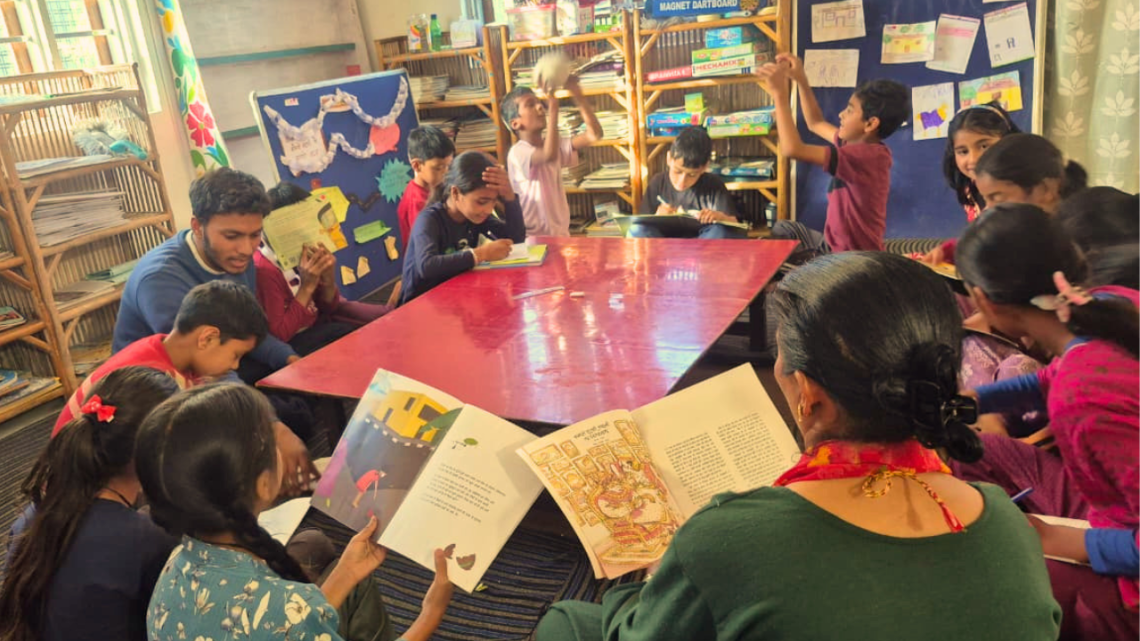
It is a beautiful evening at the library. Children sit in a circle on the floor, and in one corner sits Asha. In her hands is a book called Chal Mere Matke Tammak Tu. As she reads, her eyes drift to the children, they are building the story further with their own words and thoughts. Asha listens with a smile, and quietly becomes a part of their conversation.

Today, Asha is connected with an NGO called Rang Karawan. This is the place where children come to the library every day, and Asha comes as a teacher, letting the library reawaken her own hunger to learn. Children’s books, their curious questions, their wandering thoughts, in the middle of all of this, Asha is meeting again that part of herself she had left behind somewhere.
She has lost much in her life, endured much, but one thing she never let go of was the desire to learn. Her eyes still carry that same light they had in childhood. The only difference is that before, that light burned for her own dreams, and now it burns for her children.
Asha did not choose bitterness. She did not choose to complain. She chose to begin again. And that is why, even at 45, carrying such deep sorrow in her heart, she still laughs, still jokes, and still works with dedication.
Today, when the people of the village see Asha, who turns every hardship into a smile and works with quiet devotion, they do not know that this smile has survived so many broken dreams. Inside her, even now, the pain of watching the age limit for government jobs pass her by is very much alive. But even so, she speaks to me with a kind of positive energy and courage, “Whoever truly wants to learn, will learn anything. And whoever truly wants to study, will find a way, no matter what.”
She says, “I will never get my daughter married without her having some livelihood of her own. The circumstances I struggled through, I will never let those same circumstances enter my daughter’s life.”
Strength, or the Weight of a System?
She is no longer just a mother or a homemaker who is dedicated, patient, and full of humor. She is also someone who dares to dream, someone full of life. For her, learning has no age, and perhaps it is this understanding that leads her toward breaking a cycle that has passed from one generation to the next. She had decided from the very beginning that if she had daughters, she would end this pattern with herself.
We often look at women from the mountains and speak of their mental and physical strength, and they truly are strong. But many times, in admiring that strength, we forget to question the system that forces them to carry so much, the work of the home, the work of the fields, the care of the cattle, and every responsibility that so often falls only on women.
This is sometimes called “the labor of love,” and to some extent, that is true. But these words do not challenge the roles that are handed to a girl the moment she is born.
Sitting with Asha’s story, perhaps this understanding too begins to shift, slowly, that strength is not just something to be witnessed, but something whose reasons must also be understood.
Meet the storyteller

Sangeeta Dev
Sangeeta is a choreographer who loves reading children's literature and exploring new ideas and ways of thinking. She is currently on a journey of understanding her own emotions, and is someone who seeks to go beyond just knowing people, she tries to understand life itself, deeply and thoughtfully. Sangeeta is part of Sachin's team as a storyteller.
संगीता एक कोरियोग्राफ़र है और उसे बच्चों का साहित्य पढ़ना और नई चीज़ों को जानने-समझने की कोशिश करना पसंद है। हाल ही में वह अपनी भावनाओं को समझने की कोशिश कर रही है, और वह सिर्फ खुद को, लोगों को ही नहीं बल्कि जीवन की चीज़ों को गहराई से समझने वाली इंसान बनने की कोशिश कर रही है। संगीता सचिन की टीम में एक कहानीकार के रुप में जुड़ी हैं।

Voices of Rural India
Voices of Rural India is a not-for-profit digital initiative that took birth during the pandemic lockdown of 2020 to host curated stories by rural storytellers, in their own voices. With nearly 80 stories from 11 states of India, this platform facilitates storytellers to leverage digital technology and relate their stories through the written word, photo and video stories.
ग्रामीण भारत की आवाज़ें एक नॉट-फ़ॉर-प्रॉफ़िट डिजिटल प्लैटफ़ॉर्म है जो 2020 के महामारी लॉकडाउन के दौरान शुरू हुई थी, जिसका उद्देश्य ग्रामीण कहानीकारों द्वारा उनकी अपनी आवाज़ में कहानियों को प्रस्तुत करना है। भारत के 11 राज्यों की लगभग 80 कहानियों के साथ, यह मंच कहानीकारों को डिजिटल तकनीक का प्रयोग कर और लिखित शब्द, फ़ोटो और वीडियो कहानियों के माध्यम से अपनी कहानियाँ बताने में सक्रीय रूप से सहयोग देता है।

You May Also Like
जो पहाड़ों ने नहीं बताया…वो आशा ने बताया

गाँव में आऊट आफ स्टौक, शहर में ओवर स्टौक