We Belong to This Soil
The Story of the Himachali Gorkhali Community
Born from the glow of a hearth fire, this story unfolds an unspoken journey stretching from the hills of Nepal to the valleys of Himachal, where homes were built, fields were tilled, uniforms were worn, yet the word “outsider” lingered. Through a grandmother’s memories, names caught in bureaucratic paperwork, the closed doors of the panchayat, and the steady beat of festival drums, one question continues to echo: If the bones have already become part of this soil, how much more proof must one offer to belong?

Storyteller : Shanti Devi
Himal Prakriti Storyteller
Village Banoru, District Kangra,
Himachal Pradesh
Read this story in Hindi
When the first light of morning slips down the peaks of the Dhauladhar and reaches our village of Palampur in Kangra district, it feels as though the mountains have cradled the sun in their folds all night long. The air carries the damp fragrance of pine, soft, resinous, laced with the scent of moist earth. Breathing it in, I stand at the threshold of my home, from where the road ahead and the open garden stretching beyond it are clearly visible.
For most of the year, the field across the road remains quiet, dew resting on the grass, cows grazing along the edges, the faint imprints of children’s feet pressed into the soil. But on the days of the fair, the same ground transforms. Suddenly, rows of bright tents rise as if overnight, towering swings stretch toward the sky, and strings of balloons tremble in children’s fists. Just behind the field, on clear days, the snow-white peaks of the Dhauladhar shimmer in view, as though they too are watching the festivity from afar.
And yet, the true heartbeat of my village does not lie in that field, but a little beyond it, hidden in the shade of tall eucalyptus trees.

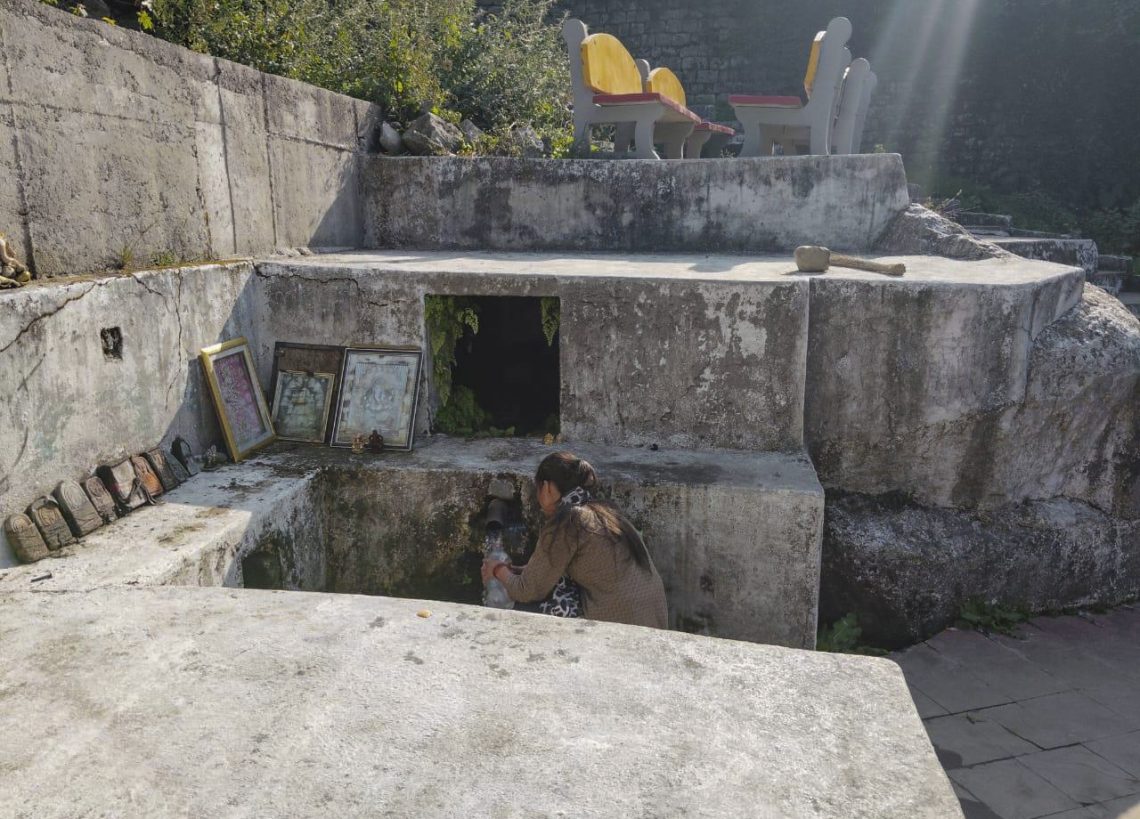
About fifty steps from my home, just to the right of the road, a stone staircase descends into a babdi—an underground water reservoir. From above, it appears to be nothing more than an open square mouth in the earth. But as soon as you begin to walk down the steps, a different world of coolness opens within. The green sheen of moss clinging to the walls, the faint ripple on the water’s surface, and the worn impressions of countless feet along the descending steps together make the place feel suspended outside of time.
This babdi is one of the greatest treasures of my village. In today’s times, when most water sources have dried up and even tap water arrives only with difficulty, this reservoir remains filled throughout all twelve months of the year. The water is icy cold, clear, and sweet. No matter how fierce the sun blazes above, the air turns instantly cool the moment you step down.
Early in the morning, women from different villages gather here. The clink of metal pots, the soft chime of anklets, and the murmur of shared conversations turn the babdi into a meeting place. Sumitra ji, who comes from a neighboring village, tastes the water each time and smiles, saying, “The sweetness in this, you won’t find it anywhere else.” And truly, the water cupped in one’s palms does more than quench thirst; it feels as though it carries the memory of this land into you.

It was fifteen years ago.
Evenings used to be the most beautiful part of our day. As the sun began to lean toward the slopes, the sky would soften from pale orange to pink, and along the village footpath our shadows would stretch long and walk beside us. In our hands we carried empty pitchers, brass and plastic, that chimed lightly with every step.
By the time we reached the babdi, the air would turn cool. The leaves of the eucalyptus trees rustled overhead, and the stone steps, having released the day’s heat, were now cold to the touch. As soon as we descended, the dampness and stillness inside would envelop us.
I would always rush ahead to touch the water first, and every time my fingers would go numb. I would snatch my hand back and declare in mock indignation,
“No, I’m not filling the water today! It’s too cold!”
That was enough to spark small quarrels.
“Then why did you even come?”
“She does this every time!”
Someone would drop her pitcher to the ground with a thud. Someone else would sit on the steps and dip her feet into the water.
Slowly, the urgency of filling water would fade. We would linger there, on the stones, on the steps, leaning against the walls. Someone would tug at another’s braid. Someone would reveal a secret. Someone would begin narrating the story of a scolding received earlier that day. Our laughter would strike the stone walls, echo, and then spread across the surface of the water in soft ripples.
Above us, the sky would deepen in color. Inside the babdi, darkness would descend little by little, and the surrounding sounds would thin out, leaving only the occasional splash of a bucket dipping into water.
Then suddenly, from a distance, a mother’s voice would rise—
“How long is it taking?”
“Have you still not filled the water?”
There would be worry woven into those calls. We would glance at one another, laugh nervously, and spring into action. Quickly we would fill our pitchers and, balancing them carefully on our heads, hurry back home. Even along the way, the laughter would not stop.
Today, when evening falls and the sky drapes itself in that same orange hue, it feels as though the babdi is still waiting, for our carefree voices, for those fingers numbed by cold water, for the long shadows that once paused upon its stones.
Even now, at dusk, the memory of that cold water and those mischievous laughs returns on its own.
The babdi never once asked me my name. It never asked my caste, the language in which I dream, or which mountain my ancestors came from. It never questioned me or my community, for being Gorkhali. Whenever we descended its steps, it welcomed us the same way each time, with its cold, sweet water. In the faces bending over its surface, it saw no difference. To it, we were simply thirsty people, and it was simply a source. Perhaps that is why we find peace beside it. Because it accepts us as we are, without condition.
We have always considered Himachal our home. On the slopes of these hills, we learned to walk; in these winds, our first breaths dissolved. The dusty paths we took to school are the very paths that witnessed our childhood races. When the first drops of rain fall upon the soil and that scent rises, it does not feel like it belongs anywhere else, it feels like ours.
And yet, strangely enough…
On the very land where I placed my first steps, I still have to prove who I am. In documents, in questions, in lingering glances… again and again. Sometimes because of my name. Sometimes because of the shape of my face. Sometimes simply because we do not “look like” we belong here.
And then only one thought rises within me:
If this babdi accepts us as its own, why can’t people?

People often say the same kinds of things about us:
“Gorkhali people are hardworking.”
“They’re honest.”
“They’re trustworthy.”
On the surface, these sound like compliments.
In the village, if someone needs night watch, harvesting in the fields, or sacks of cement carried up a steep climb, our name is the first to be called. “Call a Gorkha, he’ll do the job sincerely,” people say.
But sometimes I wonder, are we meant only to be trusted? Is hard work the entirety of our identity?
Because this identity has never quite turned into rights. We tilled the fields, but the land never became ours. We built houses, but our names were never written on their walls. We cleared the roads, but those roads never led us toward belonging.
My grandmother often sighs and says, “We have watered this land with our sweat… and yet, the land is still not in our name.”
Fire, Stories, and Unfinished Land
Grandmother would sit beside the hearth, in the very corner where the wall had darkened with years of smoke. When she stirred the burning logs with the iron tongs, tiny sparks would leap into the air with the ash, and for a fleeting moment a red glow would wash across her face. Her wrist trembled slightly. Her white hair shimmered in the firelight. The deep lines beneath her eyes seemed to grow darker in the flickering shadows. And whenever she paused mid-sentence, it felt as though even the air in the room had stopped to listen.
It was a long winter evening. Outside, fog clung to the windowpanes; inside, the hearth burned a deep red. My sister, my brother, and I sat close to the fire, our knees drawn to our chests. When a fresh piece of wood was placed into the flames, sparks flew upward and trembling light spread across the walls. In that shifting glow, Grandmother began to speak of Nepal.
She set the tongs aside gently and said, “I was twelve… when we came here.”
Her voice seemed to open into an old, winding road.
She told us that in Nepal there was plenty of land. But the crops that grew there never stretched beyond filling one’s stomach. The soil was fertile, yet there was no certainty of daily income. From morning till evening, there was labor but the household’s needs remained unmet.
One day, she said, her father quietly made a decision: to cross the mountains, to leave home, to try his luck in a new place. A twelve-year-old girl, a few bundled belongings, and a long road ahead. Whether she turned back for one last look, she never clearly said. She would only add, “We never returned.”
After that sentence, her voice would often grow faint. The wood in the hearth would crackle, and a long silence would settle into the room.
“We used to sing…” she once said softly, and that half-finished smile appeared on her lips again.
In her eyes, along with the reflection of the fire, something else would flicker, perhaps sunlit days, perhaps the courtyard she had left behind. The wrinkles on her face seemed to trace the very paths she had once walked.
As I watched her, I would think: Nepal was not just a place for her. It was a home that lived within her, a home she had carried all the way here.
Her father’s decision had been born of compulsion, of responsibility and the hope for a better life.
In Palampur, he opened a small tea shop and also worked in the fields. He cleared barren land and wild thorny bushes with sheer hard work, turning it into a place fit for living.
Grandmother would always say, “Once the soil touches your feet, it becomes yours, no matter where you come from.”
And truly, the soil that clung to her feet had now become ours.
Papers and a Face
The story of my grandmother’s father stretches across time and comes to rest in the present, with Krishan Bahadur.
Krishan Bahadur, from the Gorkha community, spent years in the uniform of the Indian Army, standing guard across mountains, borders, and snowbound posts. For twenty-eight years, his name was marked in attendance alongside the nation. After retiring, he thought he would lay down his rifle and take up a plough, settling peacefully with his family. He made his home in the Kullu valley, in a small village called Dobhi. He believed that in the country for which he had spent half his life standing watch, asking for a piece of land would not be a question, it would be a right.
But the moment the uniform came off, it was as though belonging did too.
One day, carrying neatly pressed documents, he went to a government office. His file contained his service certificates, carefully arranged, stamps, signatures, dates. The clerk glanced at them briefly, then slid the file back across the desk. “You’re Nepali… why are you buying land here?”
Without raising his voice, Krishan Bahadur pushed his documents forward again. “I have twenty-eight years of service,” he said. But in that room, the weight of the gaze fixed upon his face felt heavier than the rustle of papers. It was as if a deep line had been drawn between who he was in uniform and who he was without it. The file was pushed aside. The conversation stopped there.
To this day, he has not been able to buy land in that village.
In our village, people call us “Gorkha.” Sometimes the word is spoken with a hand resting warmly on the shoulder; sometimes it is spoken from a slight distance. When said with affection, it carries trust that we will stand by others, no matter the time. But when said with distance, an invisible line can be felt, as though there is still hesitation in fully calling us their own.
At times, I wonder, is identity decided only by papers? Or by the hands that have carved homes out of this soil?
Grandmother says that when it is time to form a government, we suddenly begin to seem like everyone’s own. But we know that we are often treated as a vote bank.
We cast our votes, attend panchayat meetings, and try to register our names under government schemes. Yet when it comes to the real documents of identity, ration cards, land records, caste certificates, that is when we are suddenly told we do not belong here.
Across the Desk
Last year, in 2024, it was a long and exhausting day. Radha, my neighbor’s sister, went to a government office with her husband to apply for a ration card.
As soon as they stepped inside, the dim light of the room fell harshly on their eyes. The constant tapping of computer keys and the low whirring of a printer cut through the stillness. A chair scraped here, a file flipped there, small sounds that revealed the weary rhythm of the office’s daily routine.
Radha placed her documents before the officer. Her hand trembled slightly, though her voice remained steady. “Sir, we need to get a ration card made.”
Without properly looking up, the officer glanced at the file and said, “You people are outsiders. Your documents are incomplete.”
A small jolt ran through Radha, but she gathered her courage. “Sir, my grandfather was born here. We even have voter ID cards.”
The officer laughed. The sound of it lingered in the room. “Casting a vote is easy. Becoming a real Himachali isn’t.”
Radha felt as though the ground had slipped from beneath her feet. The printer’s whirring, the clatter of keyboards, the rustle of files, each sound seemed to deepen the insult.
As she walked out, she said quietly, “The same people who trust us by day call us outsiders by night.”
Her voice shook, with anger and with hurt. The office, the officer’s laughter, the world of papers and stamps, all of it stirred within her both a wound and a new resolve, at the same time.

Honesty and hard work are our strengths, but sometimes, these very words end up binding us. Because when identity rests on being “good” or “trustworthy,” equality slips away, leaving behind only a conditional acceptance.
I still remember how often I heard this in school:
“So, you’re Nepali, right?”
“Why are your eyes so small?”
“Are you Hindu or Muslim?”
Sometimes it was said in jest, sometimes as a taunt. In the beginning, it didn’t affect me. But slowly, I understood that these were not just words, they were a distance being drawn. I would keep wondering why we were seen as different. Is belonging to Himachal decided only by community, caste, and paperwork?

The Soil of Home, Closed Doors
Once, I asked my grandmother, “Dadi, do you ever want to go back to Nepal?”
She was absentmindedly tracing a line in the courtyard soil with her finger. She remained silent for a moment, then said, “What Nepal now? Our bones belong to this soil. If we are uprooted from here, where would we go?”
There was no fear in her voice, only a steady truth. I kept looking at her. It felt as though the question was not hers alone. I cannot imagine leaving Himachal and living anywhere else myself, not even in Nepal.
Sometimes she would tell us how her father built their first house here. “It was a small mud house, with a slate roof. During the rains, the drops beat down so loudly on the roof that we had to raise our voices to be heard.” She would smile faintly. “That’s where we lived when we were little.”
I often wonder: if someone spends an entire lifetime turning a place into home, can they still remain an ‘outsider’?
Today, the women of our community are no longer as silent as they once were. In panchayat meetings, my mother and her friends no longer sit at the back with their heads lowered. They carry papers with them and questions.
That day’s meeting stretched longer than usual. The room was small, but the voices inside it were heavy. Men occupied the chairs at the front; the women stood at the back against the wall, files clutched in their hands.
When the matter of adding a family from our community to the official list came up, the pradhan said, without looking up, “There is no need for this.”
His tone was flat, as if the decision had already been written.
For a moment, silence settled over the room. The women glanced at one another; someone pressed her lips together, someone tightened her grip on the file.
One woman asked clearly, “How will the children move ahead in school without their name on the list?”
The pradhan leaned back in his chair. “These are the rules.”
The papers remained on the table. The meeting ended there but the question lingered in the walls.
The next morning, the women set out for the tehsil office. Mist lay spread across the mountain road, damp earth clinging to their shoes. At the bus stop, they stood quietly, one staring toward the distant hills, another softly repeating concerns about the children’s education: “What will happen after Class 12?”
In their hands were a few folded documents, some application forms and between them, patience.
Inside the tehsil office, there was a faint chill. A fan rotated overhead, and the repeated flipping of papers cut through the silence. The women sat upright in their chairs, backs straight, as if unwilling to let their resolve slacken.
They laid out everything before the officer: the refusal in the panchayat, the children being excluded from schemes without their names on the family list, the fear of incomplete education.
The officer closed the file. Thought for a few moments. Then said, “The name will be entered.”
In that single sentence, it was as if frozen breaths began to thaw. Within a few days, their name appeared on the village panchayat list, a single line of ink on paper, but for them, a solid place.
Their name was somehow recorded but this path is not so straightforward for every Gorkha family. Even today, many in our community remain deprived of their rights.
The truth is,
“Our children deserve equality in school.”
“We need identity documents.”
“We belong here too.”
These words should be spoken not with hesitation, but with pride.
Voices Rising in the Field
In the evening, a few of us sat in a circle at one corner of the field. The grass was still damp with a faint trace of moisture. Maya held her phone in her hand; on the screen glowed a photograph of Mary Kom.
“Look,” Maya turned the screen toward us, “after so many hardships, she reached here.” She paused, then added, “And as a Gorkha, she brought pride to the whole of India.”
Someone said softly, “That’s why we shouldn’t hide our identity.” Lata nodded, “If she can do it, then we can speak up for our rights too.”
For a few moments, there was silence. A coolness had begun to settle into the air. Then someone smiled and said, “Mary Kom is not just an athlete, she is courage itself.”
Now the youth of our community are becoming more aware. On social media, they write openly about their language, culture, and concerns. Alongside their studies, they are learning about their rights, meeting in small groups, and working together. From this very spirit, some people formed the ‘Gorkhali Manch’, a space where problems are not suppressed but placed openly for discussion.
On that same platform, folk songs are sung, old melodies rise again, because culture lives on like breath itself.


Sunlight, Tika, and the Beat of the Drum
It was the morning of Dashain (Dusshera). Sunlight had poured into the courtyard, and there was a gentle chill in the air. Grandmother arranged rice grains and red tika on a brass plate. One by one, she applied tika to everyone’s forehead. As she pressed the grains of rice in place with her fingers, her touch felt steady and deliberate.
From the kitchen came the aroma of hot oil. My elder sister stood by the kadhai, making sel roti. She poured the ring of batter carefully into the oil; within moments, it puffed up and turned golden. Its fragrance spread through the entire house.
Neighbors from around were invited too. My sister placed the freshly fried sel roti onto leaf plates, serving it with potato–sesame chutney. People ate with relish, someone praised the chutney, someone said, “Today is truly delightful.”
Just then, an aunt from next door picked up the drum. The beat of the dhol echoed against the courtyard walls. Amid laughter and rhythm, people rose to their feet. Some formed a circle and danced; others carried the song forward, line by line.
Grandmother sat nearby. Sometimes she watched my sister’s hands, sometimes the people dancing. Then she said softly, “Dashain was just like this in Nepal too.”
Between the sunlight, the tika, the sel roti, and the beat of the drum, it felt as though the two mountain lands, Nepal and Himachal, had come together in a single courtyard.
A Home of Three Languages
In our home, Nepali, Hindi, and Pahari are still spoken. The moment we speak to our grandparents, our tongues naturally turn to Gorkhali; with our uncles and aunts, words begin to flow in Pahari; and as soon as we step across the threshold, conversation effortlessly shifts into Hindi. At times, it truly feels as though our home is a small confluence of three rivers, each language flowing through it with its own distinct warmth.
Often, all three generations begin speaking at once, each in a different language. For a few moments, everything becomes tangled, and then we burst out laughing, wondering which language the conversation is actually happening in. Some of my grandmother’s Gorkhali words sounded so soft and tender that we carried them with us to school, “Ma timilai maya garchu.” Our friends would ask in surprise, “What language is that?” And inside, we would feel a quiet, unspoken pride.
The deepest moments come when Grandmother tells her old stories in Gorkhali. In her words, the soil of the past still clings, journeys, homes, mountains. And when Mother scolds us in Pahari, even the scolding carries a special affection, as though the language itself has become an embrace.
That is why my identity does not rest in just one place. I am Gorkhali, I am Pahari, and I am Indian. When people ask, “Where are you really from?” I realize that my identity cannot be confined within a single boundary. It is shaped by three languages, three cultures, and three emotional worlds. Yet the moment I step across the threshold of home, the question dissolves, because here, all three languages come together to assure me that I belong. Our true identity lives in this blending: situated between two countries, yet holding a relationship with both.
Today, I am not telling only my own story, I am telling the story of my entire community.
We Gorkhali people are an inseparable part of this soil, of the fields, the schools, the roads, the temples, and the homes where the scent of our labor lingers. We are not asking for acceptance; we are asking for our rights, equality, dignity, and recognition. That is the essence of our struggle, and it is also our hope, because this generation is no longer silent. We speak for our rights, we write, and we listen to one another’s stories.
I, Shanu, a Gorkhali daughter,
want to say through this story:
Our identity is not defined by our hard work alone,
but by our very existence.
We are not foreigners; we are descendants of this soil.
And one day, when a child in school asks, “Who are the Gorkhalis?”
the answer will be:
“They are the people who gave these mountains their home and their heart.”
Meet the storyteller

Shanti Devi
Shanti lives with her parents in the small village of Banoru, near Palampur in Himachal Pradesh. She completed her undergraduate studies in 2015 and subsequently pursued a one-year PGDCA (Post Graduate Diploma in Computer Applications). In 2018, she began her professional career as a Data Operator at a private bank. In 2020, she worked as a Data Operator at Medipol Pharmaceutical Company in Baddi. In 2021, she spent a year teaching at a school. In 2023, she became associated with Himachal Queer Foundation, where she actively worked with gender and queer communities. At present, she volunteers with Parvatiya Mahila Vikas Trust, contributing to work in the field of mental health. Shanti is deeply fond of traveling in the mountains; nature and the hills are a source of energy and peace for her.
शांति हिमाचल प्रदेश के पालमपुर के पास स्थित छोटे-से गाँव बनोरू में अपने माता-पिता के साथ रहती हैं। उन्होंने वर्ष 2015 में स्नातक की शिक्षा पूरी की और इसके बाद एक वर्ष का पीजीडीसीए (PGDCA) किया। वर्ष 2018 में उन्होंने अपने करियर की शुरुआत एक निजी बैंक में डेटा ऑपरेटर के रूप में की। 2020 में उन्होंने बद्दी स्थित मेडिपॉल फार्मास्यूटिकल कंपनी में डेटा ऑपरेटर के पद पर कार्य किया। 2021 में उन्होंने एक वर्ष तक स्कूल में अध्यापन किया। वर्ष 2023 में वह हिमाचल क्वियर फाउंडेशन से जुड़ीं, जहाँ उन्होंने जेंडर और क्वियर समुदाय के साथ सक्रिय रूप से काम किया। वर्तमान में वह पर्वतीय महिला विकास ट्रस्ट के साथ वालंटियर के रूप में मानसिक स्वास्थ्य के क्षेत्र में कार्य कर रही हैं। शांति को पहाड़ों में घूमना बेहद पसंद है; प्रकृति और पहाड़ उनके लिए ऊर्जा और सुकून का स्रोत हैं।

Voices of Rural India
Voices of Rural India is a not-for-profit digital initiative that took birth during the pandemic lockdown of 2020 to host curated stories by rural storytellers, in their own voices. With nearly 80 stories from 11 states of India, this platform facilitates storytellers to leverage digital technology and relate their stories through the written word, photo and video stories.
ग्रामीण भारत की आवाज़ें एक नॉट-फ़ॉर-प्रॉफ़िट डिजिटल प्लैटफ़ॉर्म है जो 2020 के महामारी लॉकडाउन के दौरान शुरू हुई थी, जिसका उद्देश्य ग्रामीण कहानीकारों द्वारा उनकी अपनी आवाज़ में कहानियों को प्रस्तुत करना है। भारत के 11 राज्यों की लगभग 80 कहानियों के साथ, यह मंच कहानीकारों को डिजिटल तकनीक का प्रयोग कर और लिखित शब्द, फ़ोटो और वीडियो कहानियों के माध्यम से अपनी कहानियाँ बताने में सक्रीय रूप से सहयोग देता है।

