Chehni Kothi: A Marvel of Himalayan Architecture
Standing amidst towering deodar trees, Chehni Kothi becomes a question at first glance, is it a king’s fort, or a watchtower where the entire village once gathered in times of danger? This centuries-old multi-storeyed structure still stands firm, having withstood earthquakes, time, and countless stories. Nearby lies the temple of Shringa Rishi, where faith and folklore blend into one another. The villagers tell different versions of the truth, yet no single answer emerges. This is a story of that search, where walls seem to speak, and every answer unfolds into a new mystery.

Storyteller : Baleshwari Vashisht
Himal Prakriti Storyteller
Village Bandal, District Kullu,
Himachal Pradesh
Read this story in Hindi
In the deep embrace of a blue sky, where the sun’s rays kiss the towering deodar trees, we kept moving along those quiet, soothing paths. On both sides of the trail, lush green deodars stood like witnesses to an ancient tale, and the cool, whispering wind passing through them seemed to carry a secret of its own. That distinct scent and sound of the wind slowly drew us toward an unknown destination… and we arrived at Chehni village.
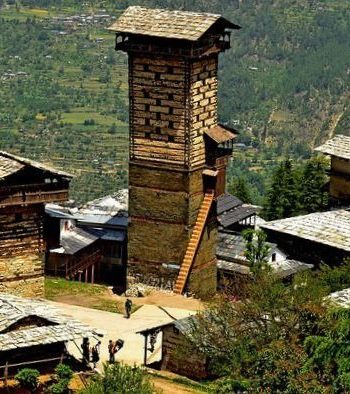
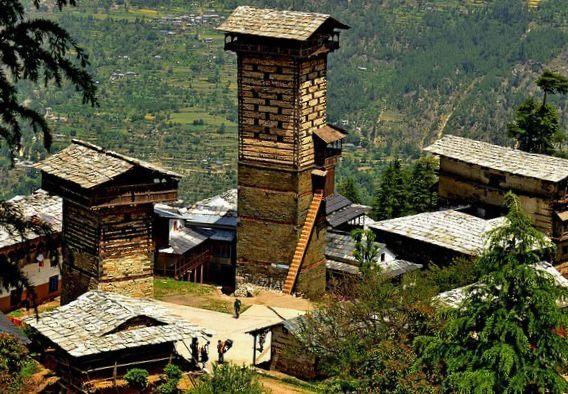
At first glance, the village felt like part of a folktale, small houses, a peaceful atmosphere nestled in the lap of the mountains, and at its center stood a remarkably grand and unique multi-storeyed structure: Chehni Kothi. Located in Chehni village in the Banjar tehsil of Kullu district, Himachal Pradesh, this is no ordinary building, but an ancient fort-tower. Built in the Kath-Khuni architectural style, it is a rare creation of stone and wood. From an architectural perspective, it is extraordinary, and its very presence tells a story of security, earthquake resilience, and spiritual belief.

With a height of about 45 meters (150 feet), Chehni Kothi was once considered the tallest tower in Himachal. Its structure is as distinctive in height as it is complex within. Inside the Kothi, small passageways and hidden corridors were built, making it not only a strong fort but also a structure filled with mystery.

Over time, this place has grown beyond history into a living cultural and religious center. Even today, devotees, history enthusiasts, and travelers visit with great interest. Some lose themselves in its architecture, while others are drawn into its stories.
The local people have known and believed in this Kothi for generations. Ask anyone, and one will say, “It is about seven hundred years old!” Another will insist, “No, no, it must be more than fifteen hundred years old.” Perhaps no one knows the exact age even today, but its years are etched into its walls, every wooden joint holding a story within.
But to be honest, in that moment, I felt no urgency to know its exact age. I was far more interested in the stories that still seemed to breathe within its walls. As the sunlight touched its heights, it felt as if it came alive again each morning. And that day, I felt as though it wanted to share its stories with me too… if only I paused long enough to listen.

Where Wood, Stone, and Earth Have Shaped a History
The grandeur of Chehni Kothi lies not only in its height or design, but also in the materials used in its construction, each carrying a deep connection to nature. The structure is primarily built using deodar wood. This is no ordinary timber, but one that has grown in the cold and moist climate of the Himalay, naturally resistant to moisture and pests. It is this strength of deodar that has kept the Kothi durable, secure, and alive for centuries. The same wood acts as a flexible shield during natural disasters, especially earthquakes.

Along with wood, strong stones such as granite and slate have been used in the foundation and walls of the Kothi. Granite, a coarse-grained igneous rock, is as hard and reliable as a warrior, while layers of slate provide balance and stability to the structure. The presence of these stones gives it the form of a firm and secure fort, one that has not only endured the test of time but has also stood witness to many generations.
But the story does not end here. What binds these strong elements together is a traditional plaster made of mud and lime. This plaster protects the walls from the harsh effects of weather, rain, cold, earthquakes, and sudden changes in climate. At the same time, it allows the structure to “breathe,” a quality that modern cement-built walls lack.
The combination of deodar wood, stone, mud, and lime makes Chehni Kothi much more than a simple building. It becomes a living structure, one that, even in silence, seems to speak of its past, its warnings for the present, and the gentle scent of the earth it is rooted in.
Kath-Khuni Architecture: A Thoughtful Weave of Wood and Stone
Amid the towering mountains, the people of the Himalay long ago adopted a unique method of construction—Kath-Khuni architecture. This is not just a technique, but a form of traditional knowledge that reflects a deep understanding of and harmony with nature.

The most distinctive feature of this style is that wood and stone are layered together, one over the other, without the use of cement or iron. No machines, no heavy technology, just skilled hands and materials provided by the mountains. Wood and stone are joined so seamlessly that they seem to merge into one another, and this very connection forms the strength of an interlocking system. The true marvel of this technique is revealed when the earth trembles. The wooden layers absorb the shocks of an earthquake, allowing the structure to sway yet remain standing. This is why buildings made in the Kath-Khuni style, no matter how old, continue to withstand the tests of time.
But this style is not only about strength. It also speaks of comfort and sensitivity. The combination of wood and stone keeps the interiors cool in summer and warm in winter, maintaining a balanced temperature regardless of the season. This is no coincidence, but the result of a deep understanding of nature and living in harmony with it. Kath-Khuni architecture is, in many ways, a philosophy of life born from the soil of the Himalay.

A King’s Fort or a Watchtower? A Question That Still Lives On
Standing at the heart of Chehni village, calling Chehni Kothi just a “kothi” almost feels like an injustice to its stature. It stands more like a sentinel, watching over the mountains for centuries. This is why it is often described as a tower-style fort, one that does not spread across the ground like palaces, but rises upward, as if in conversation with the sky.
Today, it appears to be five storeys tall. But there was a time when it stood seven storeys high. Then came 4 April 1905, when the land of Kangra trembled, and with it, two storeys of the Kothi collapsed to the ground. The earthquake measured 7.8 on the Richter scale, powerful enough to shake even stone. Yet, the spirit of this structure did not break. It stood firm, holding onto its history within its remaining five storeys.
The elders of the village often say that this was the fort of King Dhadhu. But when I asked the temple priest, he told a different story. In his wrinkled eyes, many untold tales seemed to rest. He said, “This was never a royal palace. It was a security tower, where soldiers kept watch for enemies. Whenever there was an attack, the villagers would come here for shelter. The story of King Dhadhu may just be a folktale.”
I looked at those towering walls. Their silence offered no clear answer. They neither confirmed the king’s story nor denied the priest’s words. In the rustling of the wind, it felt as though an old voice lingered, what the truth is, perhaps only these walls know.

Some elders say that the design of the Kothi was not like an ordinary residential building, it was a strategy, a system of defense. Many believe that along with security, it also served religious and cultural purposes.
It is said that the uppermost floors functioned as watchtowers of that time. From there, one could see in all directions, allowing any danger to be detected in advance. And when enemies appeared, the swords were not drawn in haste, they were already prepared. The lower floors concealed the village’s treasures, granaries, weapon stores, and perhaps even some secrets known only to the walls. The upper levels were centers of life and faith, where people lived, prayed, and turned this structure of wood and stone into a home. Each floor had its own character, each wall its own purpose. Chehni Kothi was a living strategy, a plan of its time that reflected both the intelligence and the belief of the people who built it.
Some say that the Kothi also had hidden tunnels, used as escape routes in times of crisis. Its main entrance was small and narrow, designed so that if an enemy tried to enter, they could be easily stopped. Its walls are so strong that the structure still stands firm today, while many surrounding buildings have faded away with time.
Perhaps it is this very sense of endurance and protection that adds depth to the nearby Shringa Rishi temple. While the fort stood as a symbol of physical safety, the temple became a refuge for faith. On one side, the stone walls protected the body; on the other, the temple bells held the spirit together.
Shringa Rishi: Faith, Story, or Truth?
“Have you ever heard of Shringa Rishi?”
I turned around. The priest, seated outside the temple, was looking at me. His voice was soft, yet carried a strange depth.
I nodded, “Just a little…”
He smiled gently, as if he already knew the answer.
“That Kothi you see there,” he said, pointing toward it, “is not just made of stone and wood. It holds penance… and blessings too.”

I looked toward the Kothi. Sunlight touched its upper floors, while its shadow stretched long across the ground below.
“They say,” the priest began slowly, “Shringa Rishi, also known as Rishyashringa, once came here, the son of Sage Vibhandak. It is believed that he was raised in dense forests, far from the temptations of the world. Folklore tells us that when he arrived in this region, his spiritual power was so intense that the gods themselves made this place sacred. The impact of his penance was so profound across the lands of Kullu and Manikaran that people still worship him here today.”
An elderly woman standing nearby gradually joined our conversation.
“If there is an important decision to be made, or any major task to begin, people come here first,” she said.
“To the temple?” I asked.
“Yes,” she nodded, “and earlier, they would come to the Kothi as well. This place was not just meant for living… everything was centered here, protection, and prayer.”

I looked at the Kothi again. Suddenly, it felt more serious than before, as if it wasn’t just standing there, but watching.
“Come here during Chehni Phagalni, which is celebrated in February and March,” the woman said. “That’s when you’ll truly see its vibrance.”
“What happens then?” I asked curiously.
“People from the entire region gather here,” she explained. “Offerings are made to the deity, drums echo through the air… and everyone arrives with their wishes. The temple of Shringa Rishi is believed to be a miraculous place. It is said that anyone who prays here with a sincere heart has their wishes fulfilled.”
Just then, a young man standing nearby laughed and added, “They say every wish asked here comes true.”
I smiled, “Really?”
He shrugged, “What is true, only the deity knows… but people believe it, and perhaps that’s what matters most.”
As we talked, I found myself standing at the main entrance of the Kothi. It was small and narrow, so much so that one had to bend to step inside.
“It was built that way,” a voice came from behind.
It was the priest again.
“Why?” I asked.
“So that no one could walk straight in,” he said. “Slowing the enemy was important… and once inside, it became easier to control them.”
I peered through the narrow doorway—dark, cold, and faintly mysterious. Fine cracks ran through the walls of the Kothi, as if time itself had left its marks behind.
Looking at it, I felt that this was truly not just a building. It held faith, strategy, and countless stories hidden within layers of time.
A gentle breeze passed by. The scent of deodar filled the air once again.
It seemed to me that what makes this temple special is not just the rituals, but the belief that has supported people through their most difficult moments. Just as Chehni Kothi has endured every hardship and still stands strong, I could see that same resilience in the faith surrounding this temple.
For a long time, this place has been a home to folktales, experiences, and unspoken wishes. Some things people cannot say aloud, but they find their way into prayers, carried away with the sound of temple bells. The presence of Shringa Rishi can be felt in the wind, in the sunlight, and in the silence.
When the devastating earthquake of 1905 struck Himachal and many structures collapsed, Chehni Kothi suffered only minor damage. The locals believe this to be the blessing of Shringa Rishi.

Photo: Baleshwari Vashisht
Are we only listening, or are we preserving something too?
I had heard from the villagers that this was once a king’s fort. Some call it a security tower, others believe it to be a dwelling of the gods. But when I looked up at its towering height for the first time, it felt as though it wanted to tell its own story.
An elderly local man said, “Our ancestors did not build this with just stone and wood, but with their soul.” There was pride on his face, but a quiet sadness lingered in his eyes.
The cracks in Chehni Kothi seem to carry the weight of time. In a soft whisper, they ask, “We are growing old… but does anyone still care for us?” I was reminded that many of the village’s youth have now moved to cities. Slowly, these heritage sites are slipping out of lived memory and into mere stories. And that thought stayed with me,
Are we truly preserving our heritage, or are we only repeating its stories?
Meet the storyteller

Baleshwari Vashisht
Baleshwari Vashisht is a graduate student of arts, with a deep interest in the rich devta culture of Himachal Pradesh and its remarkable cultural heritage. Having grown up in the beautiful valleys of Himachal, she has always been inspired by its natural beauty and cultural diversity. She believes that the devta culture and traditions of Himachal are an integral part of our identity and history. Her aim is to bring these traditions and this invaluable heritage to younger generations, so they can understand its significance and contribute to its preservation. Baleshwari also enjoys drawing in her free time.
बालेश्वरी वशिष्ट, कला स्नातक की छात्रा हैं, जिसे हिमाचल प्रदेश की समृद्ध देव संस्कृति और इसकी अद्भुत सांस्कृतिक विरासत में गहरी रुचि है। हिमाचल की हसीन वादियों में पली-बढ़ी वाल्शेवरी ने यहाँ की प्राकृतिक सुंदरता और सांस्कृतिक विविधता से हमेशा प्रेरणा पाई है। वह मानती हैं कि हिमाचल की देव संस्कृति और इसके रीति-रिवाज हमारी पहचान और इतिहास का अभिन्न हिस्सा हैं। उसका लक्ष्य है कि इन परंपराओं और इस अनमोल विरासत को नई पीढ़ियों तक पहुँचाया जाए, ताकि वे इसकी महत्ता को समझें और इसके संरक्षण में योगदान दें। बालेश्वरी को ड्राइंग करना भी बहुत पसंद है।

Voices of Rural India
Voices of Rural India is a not-for-profit digital initiative that took birth during the pandemic lockdown of 2020 to host curated stories by rural storytellers, in their own voices. With nearly 80 stories from 11 states of India, this platform facilitates storytellers to leverage digital technology and relate their stories through the written word, photo and video stories.
ग्रामीण भारत की आवाज़ें एक नॉट-फ़ॉर-प्रॉफ़िट डिजिटल प्लैटफ़ॉर्म है जो 2020 के महामारी लॉकडाउन के दौरान शुरू हुई थी, जिसका उद्देश्य ग्रामीण कहानीकारों द्वारा उनकी अपनी आवाज़ में कहानियों को प्रस्तुत करना है। भारत के 11 राज्यों की लगभग 80 कहानियों के साथ, यह मंच कहानीकारों को डिजिटल तकनीक का प्रयोग कर और लिखित शब्द, फ़ोटो और वीडियो कहानियों के माध्यम से अपनी कहानियाँ बताने में सक्रीय रूप से सहयोग देता है।


You May Also Like