

Binjwen – A place of repose for the living
What remains of a tradition when time moves on? The Binjwen of Tseminyu reveals more than history—it opens a window into the quiet, everyday life of a community in transition. Through stone resting places scattered across the town, this story traces memory, loss, and continuity, asking what it means to belong when old rhythms begin to fade. As voices from the past and present meet—elders, families, and those who still pause—the Binjwen emerges not as a relic, but as a living witness. This is a story about small spaces that hold large meanings, and about how communities carry themselves forward, even as the world changes around them.
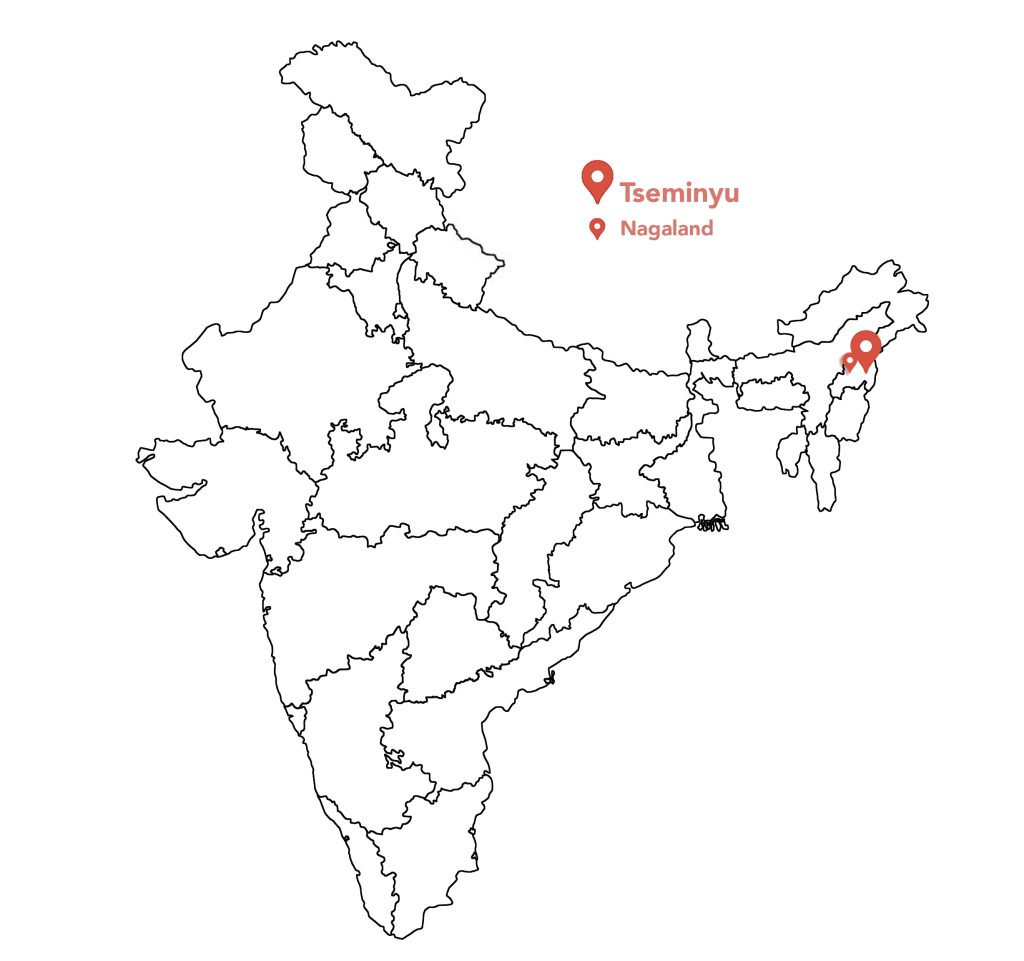
Storyteller : Kesonye Kath and Loshule Jishing
Himal Prakriti Storytelling Fellow
Village Sendenyu and Tseminyu, Tseminyu District,
Nagaland
Read this story in Hindi
The autumn sun, gentle and golden, rested on my skin like a long-awaited friend after the unyielding monsoon. As I walked through the village gate of Tseminyu that afternoon, its warmth lingered, soft, steady, almost reassuring.
At Chwida, the village gate, I slowed down, as I often do. The stones, stacked by hands more than a century ago, rose quietly before me, still firm, still holding their ground. Time had weathered their edges but not their presence. Standing there, it was impossible not to feel what they had guarded: the Rengma spirit, the long struggle for the land that holds us.
Each time I pass through Chwida, it feels like crossing a thin line between then and now. Leaves rustled somewhere above, the stones stood unmoving, and in that stillness, memory pressed close. Yet there was comfort too, something steady, something enduring. In that moment, hope did not feel abstract; it felt anchored, carried forward from the past and breathing quietly in the present.

Fifty kilometres from Nagaland’s capital, the road curves into Tseminyu village. This is Rengma land, where relationships run deep, where memory is carried not just in stories but in places that people return to, again and again.
Just inside the village gate, the path opens into a small resting space, held gently by trees and stone. It is the kind of place where footsteps slow without being told to. In the Rengma community, such resting places are called Binjwen.
This Binjwen was built by Lt. Rushulo Nsü.
In 1990, his wife, Lt. Tekhwenle Nsü, passed away suddenly, leaving behind four young children. From that moment on, Rushulo’s life shifted. In a society where men rarely stepped into the everyday labour of care, he found himself doing exactly that, moving between grief and routine, learning how to hold a household together while carrying loss quietly within him.
The Binjwen stands in her name.
It holds remembrance in its stones, of a woman who anchored her family, and of a man who chose to honour her not with words, but with a place where others could sit, rest, and remember. Even now, it remains there at the village gate, offering shade, stillness, and the quiet endurance of love.

In the Rengma community, a Binjwen is a stone monolith built as a resting place along mountain paths. It was first raised for farmers, a pause carved into steep trails during the long cultivating season, usually around November. Day after day, men and women stopped here, loosening the straps of baskets heavy with grain and damp earth. They would lower their loads slowly, letting tired shoulders breathe, sweat cooling as mountain winds passed through.
Its shelter did not belong only to the fields. Hunters returning from deep forests paused here too, their day’s catch resting at their feet. Foragers arrived with hands full of wild herbs, roots, or firewood, stopping just long enough to gather strength before the final walk home. The Binjwen held all of them, without asking who they were or where they came from.
Over time, its meaning began to shift.
Ten years ago, when I walked past the village gate each evening, the Binjwen still stood in its original form, stones stacked firmly in a simple circle. Farmers gathered there as dusk settled in. Their faces were flushed, skin glistening with sweat, bodies slack with exhaustion. Yet there was ease in how they sat, and a quiet satisfaction in their posture. When I greeted them, their smiles came easily, unforced, warm, alive. The Binjwen, even then, was more than stone. It was a place where labour loosened its grip, where people rested not just their bodies, but themselves.

Now, the Binjwen stands changed. The rough stones that once bore tired bodies have been replaced by smooth concrete benches, cool and clean to the touch. They look newer, but they are often empty.
It is rare now to see farmers resting there. The fields no longer pull people in the way they once did. With government rations and subsidised supplies arriving regularly, the long days of cultivation have thinned out, and with them, the need to pause along the path. The place still stands, but the rhythm that once filled it, the slow arrivals, the shared exhaustion, the quiet conversations, has faded. What remains is a stillness where movement once passed through.

I met Shyürhunlo Kent seated by the window, where the afternoon light filtered softly through a thin curtain. He wore a light, neatly buttoned shirt and a cap pulled low over his head, the kind worn out of habit rather than style. As I greeted him, he shifted slightly in his chair, lifting one hand mid-air, not to stop me, but as if already preparing to shape a thought.
Shyürhunlo Kent, a pious and veteran leader of the Rengma community, carried a quiet steadiness that came only with age. Well into his late eighties, his movements were measured, his presence calm, unhurried, attentive. When I told him why I had come, his face softened. He looked at me for a moment, almost surprised, and then quietly pleased.
“It doesn’t happen often these days,” he said softly, his voice careful. “That the young ask.”
The words stayed between us. Not heavy, but weighted.
As he spoke, his hand rose again, tracing slow, deliberate gestures in the air. He spoke of change, not with anger, not with accusation, but with the kind of acceptance that carries its own sadness. Modernisation and the steady pull of western influence, he observed, have consumed the attention of the younger generation, leaving them detached, uninterested, even indifferent to the roots that once anchored their people.
He did not raise his voice. He did not need to. The quietness of his concern filled the room.

“Binjwen is like resting on the lap of God,” Shyürhunlo said with a gentle yet unwavering conviction. “You lay down all your worries at the Binjwen.”
He let the words hang in the air, eyes drifting toward the hills as if seeing the past unfold before him. “Back then,” he continued, “no matter how heavy our khu (baskets) or how treacherous the path, we never stopped until we reached a Binjwen. It was our place of repose, a place of comfort where both our bodies and spirits could rest.”

He adjusted his cap and leaned slightly against the bench, the afternoon light falling softly across his weathered face. “In those days,” he said, “people carried themselves with dignity. Mutual respect was the strength of our community. Thievery was almost unheard of. During harvest, when the loads were too heavy to carry home in one trip, farmers would leave their produce at the Binjwen for days and no one would touch it.”
He paused for a moment and gently lifted his head toward the quiet, unfolding slopes. “You see,” he continued, “Binjwens were not built by just anyone. They were most often constructed by the nyapfü or nyada, the wealthy and generous families of the village. In the olden days, when a person grew rich, not only in rice but also in Mithuns (large domesticated cattle, also known as Gayal), cows, pigs, and fowls, they showed their abundance by giving back to the community. Building a Binjwen was not just about wealth, it was about gratitude.”
“The whole village took part,” he said, his voice steady and warm. “The men would go to the streams and rivers, sometimes far away, to collect the heavy boulders—the züda tso. The women would cook hearty meals to feed them, laughter and the smell of rice beer filling the air. Together, they built not just a resting place, but a memory of unity and strength.”
He smiled faintly. “And there’s a belief among our people,” he added. “If the Binjwen was built by a living patron, the leftover food from the feast could be taken home. But if it was built in memory of someone who had passed away it was taboo to take even a morsel back. Everything belonged to the spirit of the one being honored.”
His gaze softened. “There were no roads then, only winding trails through the forest. The Binjwen also served as a guidepost for the lost, a place of shelter for the weary. When a farmer or hunter fell ill or wandered off the path, others searched for the nearest Binjwen. It was more than just a resting place, it was a beacon of safety, a symbol of trust, and a reflection of who we were as a people.”
He turned to me then, his eyes glimmering with both pride and melancholy. “That’s why,” he said quietly, “Binjwen is not only a place to rest the body, it is where the heart of our community once rested too.”
As I sat with him, I began to understand more deeply the true importance and significance of Binjwen. Shyurhunlo comes from a generation that not only knew its meaning but lived it; where the construction, the rituals, and the essence of the place were all experienced firsthand. He spoke not from memory alone, but from a lifetime of feeling, the weight of Binjwen resting in his heart as something sacred, something lived and not merely remembered.

Taking advantage of an unexpected sunny day, I walked toward another Binjwen, the Binjwen of Lt. Loshüle Kent, on the far side of Tseminyu, at Tso Keda. I went hoping the place might still carry voices, memories, something that could tell me how it once lived.
Instead, I found it quiet.
The Binjwen stood slightly neglected, its presence easy to miss. I remembered a time, years ago, when children gathered here, lingering, playing, their laughter spilling onto the road nearby. That sound returned to me now only as memory. Those children have grown up and left, gone to study, gone to settle elsewhere. What remains is the space they once filled.
Times have shifted. Outdoor gatherings have thinned, slowly replaced by the glow of screens and the pull of technology. The Binjwen, once woven into everyday life, now stood on the edge of it.
I waited, hoping someone might pass by, someone who could tell me how this Binjwen came to be, how it was once used by the people of Tso Keda. But no one came. Perhaps it was the uncertain weather, the kind of sunshine that carries the promise of sudden rain, keeping people indoors. The stillness held. Leaves rustled softly. Somewhere, life moved on, distant and faint, while the Binjwen remained, quietly waiting.
My day and with it, my hope had begun to fade into the clear afternoon sky. I felt slightly discouraged, a little demotivated. But visiting the Lt. Holojwi Binjwen, on the opposite end of the last one I had seen at Tso Keda, rekindled that quiet flame of curiosity within me.


Photo: Kesonye Kath
From the quiet of Lt. Holojwi Binjwen, Tseminyu town opens out slowly, house by house, slope by slope. Roofs catch the afternoon light, smoke lifts gently from a few kitchens below, and the road winds through the town like a thin thread holding everything together. Sitting here, it feels possible to see not just the town, but the lives moving within it.
The Binjwen itself is old now, its stones worn and softened by time. Yet it still stands steady, holding its shape, holding its place. Set close to the main road, in one of Tseminyu’s busier localities, it has not slipped into silence. People still pause here, if only for a moment, to sit, to look, to rest. The Binjwen continues to do what it was built for.
This Binjwen was built by his family after his passing, but it carries something older than memory. Lt. Holojwi Tep, leader, educator, patriot, lived through service under the British, the Naga National Movement, and decades of guiding his community. Yet here, none of that feels distant or historical. From this stone seat overlooking Tseminyu, his life does not arrive as a list of achievements, but as a quiet continuity of watching, listening, and remaining present.
Perhaps that is why this Binjwen still feels alive. It does not only remember a man. It mirrors the way he lived, rooted, attentive, and open to those who chose to sit beside him.
As I walked through the locality around the Binjwen, I met Khwehile, a woman in her mid-thirties who lives close by. She comes here often. When I asked her about the place, she laughed softly, as if already picturing it.
“In summer,” she said, “we wait for the evenings.” She gestured toward the stone seats. “The breeze comes just right. We sit here, talk about everything and nothing and keep slapping mosquitoes.” She smiled, the kind that comes from habit, from familiarity. This was not a place she visited out of obligation. It was simply part of her day.
Listening to her, it became clear why this Binjwen still felt alive. In many places, such spaces have slipped quietly out of use. But here, people still arrive, not to remember a tradition, but to live it. The stones are warmed by bodies, the air by voices. The Binjwen continues to hold conversations, laughter, and small pauses between busy lives.
Standing there, I realised that traditions do not survive because they are declared important. They survive because people return to them, again and again, finding comfort, relief, and belonging. As long as someone chooses to sit here in the evening breeze, this Binjwen is not fading. It is simply continuing.

I sat there a little longer, letting the view settle into me, the town below, the hills holding it steady, the stone cool beneath my palm. Voices from earlier in the evening lingered in my head, as did the easy way people had spoken of this place, as if it were an extension of their homes.
Then the light shifted. The sky darkened without warning, and the first drops of rain fell, tentative at first, then certain. The air changed. I stood up, brushing my hands against the stone one last time before hurrying down the path, the rain quickening behind me, urging me on.
As I drove away, the Binjwen slipped out of sight, but it did not feel left behind. Rain tapped softly against the windshield, steady and familiar. I thought of the many pauses this stone had held, tired bodies, evening conversations, quiet watching. Long after fields thinned and habits changed, people still returned here, still sat, still waited for the breeze.
Perhaps that is how such places endure. Not by standing untouched, but by being used. By allowing people to gather, to rest, to share space, again and again. Like the rain that finds its way back to the earth, the Binjwen continues to draw people in, holding together what might otherwise slip apart.
More than just reviving a fading tradition, it is about rekindling the threads that bind us together; the brotherhood, the sisterhood, and the shared rhythm of a community that once lived so closely with the land.
Meet the storyteller

Loshule Jishing
Loshule Jishing is a primary teacher from Tseminyu Town and an alumna of Kohima College, where her love for literature first took root. A storyteller at heart, she’s deeply connected to her Naga heritage and passionate about sharing its richness whenever she gets the chance. An adventurous spirit, Loshule is always ready to step beyond her comfort zone—whether it’s through travel, learning, or new experiences that broaden her world. Loshule is a member of Kesonye Kath’s story tellers team and is active in the Kèwhen Community Media Hub.
लॉशुले जिशिंग त्सेमिन्यु टाउन की प्राथमिक शिक्षिका हैं और कोहिमा कॉलेज की पूर्व छात्रा हैं, जहाँ साहित्य के प्रति उनका प्रेम सबसे पहले उभरा। दिल से एक कहानीकार, वह अपने नागा विरासत से गहराई से जुड़ी हैं और जब भी मौका मिलता है, इसकी समृद्धि साझा करने के लिए उत्साहित रहती हैं। एक साहसी आत्मा वाली, लॉशुले हमेशा अपने कम्फर्ट ज़ोन से बाहर कदम रखने के लिए तैयार रहती हैं, चाहे वह यात्रा के माध्यम से हो, सीखने के माध्यम से या नए अनुभवों के ज़रिए जो उनकी दुनिया को विस्तारित करते हैं।

Kesonye Kath
With a background in engineering and a passion for design and all things creative, Kesonye finds meaning in connecting with her community and the natural world. She is a volunteer with the Kenono Foundation where she works on documentation and story preservation. An avid gardener, she finds peace and inspiration in tending to her plants. On days when not cozied up with her baby daughter, you'll often find her immersed in the pages of a good book. She is currently pursuing a Master’s in Education at Jamia Millia Islamia University.
इंजीनियरिंग की पृष्ठभूमि और डिज़ाइन तथा रचनात्मक चीज़ों के प्रति गहरी रुचि रखने वाली केसेन्ये अपने समुदाय और प्राकृतिक दुनिया से जुड़कर अर्थ पाती हैं। वह केनोनों फ़ाउंडेशन की स्वयंसेवक हैं, जहाँ वह दस्तावेज़ीकरण और कहानियों के संरक्षण पर काम करती हैं। एक उत्साही बाग़बान के रूप में, वह अपने पौधों की देखभाल में सुकून और प्रेरणा ढूँढती हैं। जब वह अपनी नन्ही बेटी के साथ आराम से समय नहीं बिता रही होतीं, तो अक्सर एक अच्छी किताब के पन्नों में खोई हुई मिल जाती हैं। वह वर्तमान में जामिया मिल्लिया इस्लामिया विश्वविद्यालय से शिक्षा में मास्टर डिग्री कर रही हैं।

Voices of Rural India
Voices of Rural India is a not-for-profit digital initiative that took birth during the pandemic lockdown of 2020 to host curated stories by rural storytellers, in their own voices. With nearly 80 stories from 11 states of India, this platform facilitates storytellers to leverage digital technology and relate their stories through the written word, photo and video stories.
ग्रामीण भारत की आवाज़ें एक नॉट-फ़ॉर-प्रॉफ़िट डिजिटल प्लैटफ़ॉर्म है जो 2020 के महामारी लॉकडाउन के दौरान शुरू हुई थी, जिसका उद्देश्य ग्रामीण कहानीकारों द्वारा उनकी अपनी आवाज़ में कहानियों को प्रस्तुत करना है। भारत के 11 राज्यों की लगभग 80 कहानियों के साथ, यह मंच कहानीकारों को डिजिटल तकनीक का प्रयोग कर और लिखित शब्द, फ़ोटो और वीडियो कहानियों के माध्यम से अपनी कहानियाँ बताने में सक्रीय रूप से सहयोग देता है।


You May Also Like
फोतोक्सर का निंग्पा गोंपा- युवाओं द्वारा उसके पुणर्स्थापाना की कहानी
The Ningpa Gonpa of Fotoksar: The story of it’s restoration by the youth
