
Yatur Penam: A Bridge Between the Living and the Spirit World
In the misty village of Midpu, young Kanam awakens to a sacred day—her father is preparing for BottYatur, a powerful Nyishi ritual performed to protect men from illness and misfortune. As chants echo from the baag and the Nyub (shaman) invokes ancestral spirits, Kanam begins to question the unseen world of Ui—the spirits believed to dwell in every corner of nature. Through her father’s gentle storytelling, she uncovers the significance of traditions, gender roles, and the ancestral ties of the Tani people. Set between the visible and the invisible, Yatur Penam draws you into a world where every whisper matters, and where rituals serve as bridges between the living and the spirits.

Storyteller : Taba Domina
Himal Prakriti Storyteller
Village Toru, District Papum Pare,
Arunachal Pradesh
Read this story in Hindi
The sun had not yet risen when seven-year-old Kanam awoke to a mist-shrouded Midpu, a small village tucked away in the Papum Pare district of Arunachal Pradesh. The creaking of the nyop, the bamboo flooring of their traditional home, mingled with the gentle murmur of conversation and occasional laughter of her mother and aunts as they busied themselves with preparing the morning meal. It was this familiar blend of sounds and the crisp winter air that gently roused Kanam from sleep.

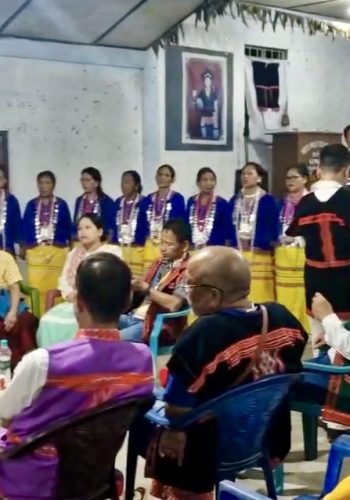
Midpu is home to the Nyishi tribe, the largest ethnic group of Arunachal Pradesh. The Nyishi way of life is deeply rooted in a profound reverence for nature, and is guided by animistic beliefs. Nyishi see the natural world as alive with, and inhabited by, spirits. They believe that maintaining harmony with these unseen forces is essential for individual and communal well-being. Ancient customs and rituals are interwoven into daily life, serving as bridges between the human and spiritual realms. One such tradition is YaturPenam, a sacred ritual once central to Nyishi life. Performed to ward off misfortune and protect the health and prosperity of an individual or family, it exemplifies the tribe’s enduring commitment to balance and harmony with the natural world.

In earlier times, Yatur was conducted for various reasons—during housewarming ceremonies (Nama Yatur), to bless the harvest, or before embarking on an important journey where protection and success were sought. Warriors and hunters performed Yatur before battles and hunts, seeking divine favour for their strength and safety. Among the different types, Bott Yatur remains the most commonly performed. It is specifically performed for male members of the family to cure illness, safeguard the household, and guard against life-threatening accidents and tragedies caused by malevolent spirits.
‘Everything around us, from the vast world outside to the quiet corners of our home, is inhabited by spirits whom we call Ui. These spirits are neither benevolent nor malevolent; they simply exist. When misfortune strikes—sickness, accident, or death—it is a sign that the spirits of Mother Nature have been angered by us. If these warnings go unheeded, the consequences can spiral into greater tragedies. There’s a delicate balance between the human world and the unseen realm of Ui.That is why we must be respectful, cautious, and mindful, for our actions and words echo not just in the world we see, but also in the one we cannot.’
This is what Kanam’s father had told her the day before during their car ride to his maternal uncle’s house. They were headed there to attend Bott Yatur, performed every three years by his family. While some observe it annually for continued well-being, others turn to it only in times of illness or misfortune.
Deeply connected to his roots, Kanam’s father often spoke of the importance of preserving one’s identity, especially in an era where the younger generations were forgetting even their native languages. Since she was four, he took Kanam everywhere whenever he got the chance to attend traditional rituals. Only a child, Kanam could not yet grasp the significance behind the rituals, but he never pressured her to understand, he only wanted her to witness them. For him, presence was enough—being surrounded by elders and the rhythms of their culture. He believes awareness will one day blossom into understanding.
It wasn’t 5 am yet, but the household was already alive with activity, only the children were dreaming. Kanam sat near the comforting glow of the fireplace, warming her palms chilled after a wash. She shot a glance at her father who sat a few paces away by another fireplace, deep in conversation with an elderly man in a worn-out grey coat and a bopia, the traditional Nyishi headgear.

Nyishi houses are, typically, long and rectangular, built from bamboo and wood, with sloping roofs made of toko okk(livistona jenkinsiana), a palm species. The botu or main entrance is often reached by a wooden or bamboo ladder. On the opposite side lies the baag, an extended platform or veranda used for socializing, resting or drying grains.

‘Come, Kanam, eat your meal,’ her mother called. The familiar aroma of kvj, a porridge made of chicken and rice, filled the air, warm and comforting against the morning chill.
A while later, Kanam saw the elderly man her father had been talking to earlier, step out to the baag. It was still dark and bitterly cold. Seated in the baag, the old man began to speak. He spoke in a steady, measured voice, as though conversing with someone invisible to Kanam. His tone shifted between earnest requests and probing questions, presumably seeking answers or negotiating. His words flowed steadily, weaving through the air like an incantation. Amidst the cadence, Kanam caught familiar names—her father’s and grandfather’s—threaded into the sacred syllables.

‘Abu (father), who is he?’Kanam asked her father, taking the roasted corn he offered her as he tended the fire.
‘He is the Nyub (shaman), Ane (little girl),’ her father replied. ‘The one who will perform the ritual. Remember what I told you yesterday in the car?’
Kanam nodded and asked again, ‘Why is he outside on the baag? It’s so cold. What is he saying?’
Her father smiled at her curiosity. ‘The Nyub cannot chant invocations inside because Yaturcarries a heavy aura, associated with accidents and sudden deaths and is, therefore, not allowed to enter the house,’ he explained. ‘The Nyub is calling Yob Ui, the guardian spirits who protect men during hunts, wars, and from unseen harm. Their protection is crucial, for without them, a man’s soul becomes vulnerable, an easy target for malevolent and mischievous Ui. Even small conflicts turn deadly. They say, with Yob Ui by your side, not even a scratch from an oyo (traditional weapon) can touch you.’

Kanam’s brows furrowed. ‘But Abu, why would Yob Uistop protecting someone?’
‘It happens when a man does something to displease them—through his actions, behaviour, or words,’ her father replied. ‘That’s why we must always do the right thing and choose our words wisely. The Ui are always watching, always listening.’
‘Then who protects me, Abu? If Yob Ui only protect men?’ Kanam asked. Her small hands wrapped around the warm roasted corn.
Her father smiled. ‘It’s not that they don’t protect women—they do. But in the old days it was mostly men who went to war and hunted, so they needed protection. I’ve never heard of a Yatur being done for women, maybe because women were rarely a part of battles or hunts.’ He handed Kanam a glass of water before continuing, ‘Don’t worry, there are rituals for women also.’
Kanam took a sip, thinking aloud.‘Can the Nyub really see spirits? Do spirits look like us?’
‘No, Ane. Spirits are formless. Ordinary people cannot see or sense them—only the Nyub can. That’s why the Nyubhold such an important place in our culture. They are the bridge between the two worlds— ours and that of the spirits. No ritual can take place without them. During a Yatur, the Nyub acts as an intermediary, communicating and negotiating with theUi on our behalf. He calls upon all the sacred elements of nature such as nyok (land), pobu (rivers), donyi-pol(sky), lvn (rocks), requesting them to unite and fortify the soul of the person or family, so they can remain protected against any present and future harm that may come their way.’
Kanam’s eyes lit up.‘Can I become a Nyub, Abu? I want to talk to the Ui too!’The spirit world she imagined in her mind felt magical, full of wonder.
Her father smiled gently. ‘One doesn’t simply choose to be a Nyub, Ane. One is born into it. From a young age, a Nyub shows rare wisdom, setting them apart. They naturally have a way with words and a deep spiritual instinct. The language they use during rituals is sacred—not the one we speak daily. Only the truly learned can clearly understand it.’
‘Abu,’ I asked, frowning a little, ‘so… if someone is a Nyub, does that mean other people can’t be one? Are they left out?’
My father shook his head with a smile. ‘No, Kanam. Anyone can be a Nyub. It’s not inherited—it doesn’t matter which family or clan you’re born into. Some are poor, some rich, but being a Nyub doesn’t make you rich. You live your life as you always did. The power is just… there, and it grows as you grow. People respect you for it and offer what they can—maybe a bottle of wine, some hens, or other meats. Some even give money these days. But at the end of the day, a Nyub lives like everyone else, and when they die, the power dies with them.’
Kanam nodded slowly, then another thought crossed her mind. ‘Abu, I heard him say grandfather’s name too.’
‘Yes,’ her father replied. ‘In our culture, family names carry deep significance. It is how we trace our ancestors back to Abotani, the forefather of all Tani people.’
The Tani people—Nyishi, Apatani, Galo, Adi, Tagin, and Mising—are a family of tribes sharing common ancestry, culture, and language, primarily inhabiting Arunachal Pradesh and some parts of Assam and the Tibet Autonomous Region (China). Though each is unique, their roots are deeply intertwined.
‘When our time here ends,’ her father continued, ‘we join the spirit world where our Abu-Apa(ancestors) live. They watch over and bless us from there, living together in homes built by those who departed there first.’
He leaned back, setting the bamboo tongs aside. ‘That’s why the Nyub invoked my name and grandfather’s—to introduce and connect us to the spirits world, so they would know exactly whose family is reaching out. If we were performing a ritual for you, the Nyub would take Abu’s name along with yours.’
Kanam watched him rise to wash his hands, his words lingering, weaving stories of an unseen world.

‘Abu, why are we doing the ritual at Uncle’s house? Can’t we do it at home?’ Kanam asked.
Wiping his hands on a towel nearby, her father nodded. ‘We can. Actually, we can perform it at any of our blood-relatives’ houses, if necessary. But doing it at one’s Kwi (maternal uncle’s) house is believed to enhance its effectiveness and blessings. In our culture, a Kwi holds a position of great respect. They are the guardians, mediators, and protectors of their sister’s family. Their role is especially significant in their nieces’ and nephews’ marriage ceremonies, where their blessings are considered auspicious. That’s why, seeking blessings and offering prayers from one’s maternal uncle’s house is considered very effective. So, my child, always respect your Kwi, care for them, and cherish their blessings. Otherwise, Anv Donyi(Mother Sun) will be disappointed in you.’
Kanam scrunched her nose. ‘But… Why is it always the uncle? Why not the aunt? Don’t her blessings matter too?’
Her father chuckled softly. ‘Of course they do. Both uncle and aunt’s blessings are precious. It’s just that earlier, when a woman got married, she moved to another home and couldn’t always be there to help. The uncle stayed, so over time people began to see him as the protector. But today, aunts are just as present and important as uncles in our ceremonies. It wasn’t about women being unimportant, but about how society functioned in those times.
Kanam nodded as her father continued, ‘However, if we choose to perform the ritual at our home, we must first seek the guidance of the Chwjw. AChwjw is the divine messenger between the Ui and the Nyub, and it is said that a Chwjw never lies. Every home is inhabited by these spirits, watching over the family. They are the guardians of our house, and their blessing is crucial before any sacred rite. To proceed without their permission would be a grave offence, as it questions their protection. This could invite misfortune, not only upon the family but also upon the Nyub performing the ritual.’
He added, ‘We can proceed only once they grant approval. But there’s a rule. When Yatur is performed at one’s own house, the altar or Yatur Yugu is built on the baag. But in a relative’s home, it is set outside on the ground. As every house has its own spirit guardians, bringing another family’s rituals into their space is considered disrespectful to the spirits residing there.’

‘How do we seek the guidance of a Chwjw, Abu?’ Kanam asked curiously.
‘Good question, Kanam! To take the Chwjw’s permission and guidance before performing the ritual at one’s home, the Nyub relies on a sacred process called Pochu Kot,’ her father said. ‘For this, he uses chicks, no older than two and a half weeks, as mediums for spiritual communication. He requests the Chwjw to make markings and patterns on the chicks’ livers as answers to his questions. He repeats the process with different chicks until the answer is clear. Sometimes, it takes a whole day or more and may require the sacrifice of many chicks—at times exceeding forty. Liver interpretation is an essential part of our rituals.’
Placing more logs onto the fire, he continued, ‘The same process is used in Yatur also, where a Rop Tvlw(a red-feathered rooster) is sacrificed to identify the offending spirits. There’s an old tale behind why we use a red rooster for Yatur and it goes all the way back to Abotani. This time, the Nyub doesn’t consult Chwjw but asks the spirits directly, “Are you the one causing harm?” The answers to Nyub’s questions are revealed in the rosin (rooster liver). Only the Nyub, or an assistant with spiritual insight, can interpret these specific markings. To ordinary people, they remain unreadable and unclear. This step is crucial before performing the larger ritual called Ui Patt(the grand ritual of the spirits), where livestock which only include chicken, pig, goat, or gayal (mithun) are sacrificed to appease the identified spirits. No further rituals can proceed without the identification.’
When the golden sun bathed the land and the warmth of the fireplace could not be compared to its radiance, Kanam and her cousin Gumsi stepped outside to play. Their make-believe kitchen, an irresistible draw for the neighbourhood children, was soon filled with more little chefs, their laughter mingling with the soft rustling of the morning breeze.
As they played, Kanam’s gaze wandered to two men working nearby. Their hands moved with practiced ease, shaping bamboo with remarkable skill. Strips of bamboo lay scattered around, some carved into slender sticks, others woven into a small pouch-like container. She watched as they carefully assembled a triangular structure.
This intricate creation is the Yatur Yugu—the Yatur altar, the main element of the ritual. The altar has its own unique design, simple yet meaningful. Two sturdy bamboo sticks stand firmly on either side, adorned with crisscross patterns etched with charcoal. At the centre stands a branch of kora svn (sweet chestnut tree), attached to the two bamboos. The kora okk (chestnut leaves) are arranged around the base of the structure; other plants cannot be used. Chuha (a small bamboo pouch) is then secured at the intersection, completing the structure.

In Nyishi tradition, each ritual altar is unique. It is crafted from natural local materials, and every part holds deep significance. The Yatur Yugu follows a fixed design, but altars of other rituals vary depending on the Uibeing invoked. The number of bamboo poles, their adornments, and the structure are not random—every detail is determined by divine guidance, which the Nyub discerns through Pochu Kot(chick’s liver interpretation). To this day, these sacred altars remain unchanged, built with wood and bamboo, reflecting the Nyishi people’s enduring bond with nature and their ancestors.

After some time, Kanam saw her father approach the altar with a neighbourhood boy who was holding a red rooster, speckled with black feathers. Kanam also joined him, watching as the boy bound the rooster’s legs and hung it upside down at the centre of the Yugu.
‘Abu, it’s that uncle’s rooster?’ she asked.
‘No, I bought it from this young boy’s family,’ he replied. ‘Kwi’s rooster is too old, and for the ritual we can’t use one that is too old or too young.’
Kanam observed the Yugu for a while, watching as the rooster occasionally flapped its wings in restless protest. Spotting a bamboo broom nearby, she picked it up and joined her friends tidying the area around the altar as her father went back inside the house.
The children remained lively, lost in their own delightful world of laughter and play until they were gently hushed. The Nyub soon descended from the baag. In Yatur, the presence of the concerned person is not essential. They may be far away, and still, their family or relatives can perform it in their name. It is also not necessary for them to be present near the Yuguduring the ceremony.
Kanam stood nearby, her eyes fixed on the Nyub as he began his sacred work. Moments later, the rooster cried out, stirring anxiously. Each time it stirred, the people around the altar produced a rhythmic humming sound called Rumdv, accompanied by Kigo, a distinct chant. This continued until the Nyubcompleted his sacred invocations. The rooster’s agitation during the chants is believed to signal the presence of the YobUi, arriving to claim the offering.
As the invocation concluded, Kanam watched the Nyub sever the rooster’s head, placing it in the Chuha tied to the Yugu. Then selecting a few feathers, he adorned the altar with them before gently swinging the rooster’s body around it, allowing its blood to anoint the structure. Though the scene may appear gory to an outsider, within the Nyishi spiritual tradition, it is believed to hold deep religious significance and is performed with reverence, not aggression, making it sacred rather than an act of harm or mindless slaughter.
A basket of tangerines rested near Kanam as she dozed on the uppi (bamboo mat), her drowsy gaze drifting between the adults gathered on the baag. Seated with her father, the Nyub and three other men were deep in conversation, carefully examining the extracted rosin (rooster’s liver), deciphering the spirits’ response. This is the moment of revelation—the signs left by the spirits are interpreted by the Nyub, offering insight into an individual’s or family’s fate.

If the Yob Ui is at peace, its protection unwavering, no further rituals are needed. But signs of trouble demand action. A troubled liver could mean one of two things: either the Yob Ui has withdrawn its protection, dissatisfied with something said or done, or a more complex scenario wherein the Yob Ui remains protective, but unidentified Uiare working against the individual or family. In such cases, Pochu Kot is performed to identify the offending spirits. Sometimes, the trouble isn’t caused by Yullo (higher spirits) but by lesser ones, or even ancestral spirits who feel forgotten by their descendants.
In rare instances, even after Ui Patt, the grand appeasement ritual, dangers still persist. This often signals a flaw in the ritual—either the spirits were misidentified, or their demands were not fully met. Such mistakes not only endanger the family involved but also the Nyub who performed it, a testament to the risk and heavy burden they carry.
Strict rules govern a Nyub’s role in rituals. They cannot perform Yatur more than once a month or for the same person more than once a year. As negotiators between the seen and the unseen, Nyubs must tread carefully—repeatedly invoking the same Ui risks angering it, with grave consequences.
Stars shimmered above, and the moonlight bathed Midpu village in its silvery glow. Inside the house, the rich aroma of tem opo (millet wine) mingled with the laughter and conversations of people. Kanam sat beside her cousin Gumsi as her mother served their dinner.

‘Ane, don’t share your chicken with Gumsi,’ her mother instructed them gently. “This is the Yatur chicken, and you can only share it with your father, understand?’ Turning to Gumsi, she reassured her, ‘Don’t worry, Ane Gumsi. We’ve cooked chicken dishes for everyone too. We’ve prepared plenty of food, choose what you want, okay?’
One of the rules of Yatur is that the sacrificed rooster can only be consumed by the person for whom the ritual was performed, their immediate family, and members of the same clan. Nyishi is a clan-based society, where members of a clan are considered kin, bound by shared ancestry—making marriage among them strictly forbidden. They can only marry someone outside their clan.
However, there is a traditional restriction that female family members who have begun menstruating are not permitted to partake in the meat, as menstruation is viewed as ritually unclean. Yet, for a community that worships nature, viewing a natural process like menstruation as religiously impure may not truly be an ancient belief. Long ago, when there were no sanitary products and women used folded cloth that often leaked or stained, led the community to see menstruation as untidy, especially during sacred rituals. Over time, this practical concern turned into a ritual taboo, causing later generations to regard menstruation itself as impure. Today, balancing reverence for tradition with a more inclusive understanding of the human body is a challenge that modern generations are increasingly called to address.
In the midst of different conversations, Kanam could hear her father lamenting how modernity has eroded so many age-old traditions. She often heard her father speak of how costly it has become to hire a Nyub nowadays, as they must be brought from faraway villages, because in some areas there are none left. Today, only the followers of Donyi-polo, one of the indigenous faiths of Arunachal Pradesh, continue to uphold these sacred traditions. Centred around the worship of Donyi (the Sun) and Polo (the Moon) as supreme deities, their devotion keeps the tradition of their ancestors alive.
Watching her father’s perseverance and understanding the depth of his efforts, Kanam made a silent vow in her heart to stand alongside her father and help him protect their culture and traditions that had shaped their very being.

Meet the storyteller

Taba Domina
Taba Domina is a twenty-four-year-old from the village of Toru, Papum Pare district in Arunachal Pradesh. She has completed her Bachelors and Masters in English Literature and is currently pursuing a B.Ed. She loves to sing, read, write and is a lover of lyricism. She hopes to one day become a good lyricist in her language, Nyishi.
ताबा डोमिना अरुणाचल प्रदेश के पापुम पारे जिले के टोरू गाँव की 24 वर्षीय युवती हैं। उन्होंने अंग्रेजी साहित्य में अपनी स्नातक और स्नातकोत्तर की डिग्री पूरी की है और वर्तमान में B.Ed. की पढ़ाई कर रही हैं। उन्हें गाना, पढ़ना, लिखना और काव्यात्मकता से प्रेम है। वह एक दिन अपनी भाषा, न्यिशी में एक अच्छी गीतकार बनने की आशा रखती हैं।

Tani Language Foundation
The Tani Language Foundation (TLF) is a student-founded not-for-profit entity dedicated to reviving the ancient Tanilanguage and its rich cultural heritage. Rooted in regions of India and China, TLF unites Tani dialects to preserve ancestral traditions and linguistic diversity. Through open-source archives, language resources, and a commitment to simplifying the Tani script, TLF empowers communities to reclaim their identity. Driven by love for their resilient ethnicity, TLF strives to safeguard the Tani people's voice and legacy, ensuring it thrives on for future generations.
तानी भाषा फाउंडेशन (TLF) एक छात्र-स्थापित गैर-लाभकारी संस्था है, जो प्राचीन तानी भाषा और इसकी समृद्ध सांस्कृतिक धरोहर को पुनर्जीवित करने के लिए समर्पित है। भारत और चीन के क्षेत्रों में स्थापित, TLF तानी बोलियों को एकजुट करता है ताकि पूर्वजों की परंपराओं और भाषाई विविधता को संरक्षित किया जा सके। ओपन-सोर्स पुरालेख, भाषा संसाधनों, और तानी लिपि को सरल बनाने की प्रतिबद्धता के माध्यम से, TLF समुदायों को उनकी पहचान को पुनः प्राप्त करने में सशक्त बनाता है। अपनी मजबूत जातीयता के प्रति प्रेम से प्रेरित, TLF तानी लोगों की आवाज़ और विरासत की रक्षा करने के लिए प्रयासरत है, यह सुनिश्चित करते हुए कि यह भविष्य की पीढ़ियों के लिए जीवित रहे।

Voices of Rural India
Voices of Rural India is a not-for-profit digital initiative that took birth during the pandemic lockdown of 2020 to host curated stories by rural storytellers, in their own voices. With nearly 80 stories from 11 states of India, this platform facilitates storytellers to leverage digital technology and relate their stories through the written word, photo and video stories.
ग्रामीण भारत की आवाज़ें एक नॉट-फ़ॉर-प्रॉफ़िट डिजिटल प्लैटफ़ॉर्म है जो 2020 के महामारी लॉकडाउन के दौरान शुरू हुई थी, जिसका उद्देश्य ग्रामीण कहानीकारों द्वारा उनकी अपनी आवाज़ में कहानियों को प्रस्तुत करना है। भारत के 11 राज्यों की लगभग 80 कहानियों के साथ, यह मंच कहानीकारों को डिजिटल तकनीक का प्रयोग कर और लिखित शब्द, फ़ोटो और वीडियो कहानियों के माध्यम से अपनी कहानियाँ बताने में सक्रीय रूप से सहयोग देता है।


You May Also Like

गॉन्ग डायरीज़ – माउथ हार्प बजाने वाली बुगुन जनजाति की दादी
The Legend of the Ekki: Tani People and their Dogs